Let me bring you to a parable of the Saviour found only in Matthew’s gospel account: 13:24-30. Here it is in the ESV – read it prayerfully with me.
24 He put another parable before them, saying, “The kingdom of heaven may be compared to a man who sowed good seed in his field, 25 but while his men were sleeping, his enemy came and sowed weeds among the wheat and went away. 26 So when the plants came up and bore grain, then the weeds appeared also. 27 And the servants of the master of the house came and said to him, ‘Master, did you not sow good seed in your field? How then does it have weeds?’ 28 He said to them, ‘An enemy has done this.’ So the servants said to him, ‘Then do you want us to go and gather them?’ 29 But he said, ‘No, lest in gathering the weeds you root up the wheat along with them. 30 Let both grow together until the harvest, and at harvest time I will tell the reapers, Gather the weeds first and bind them in bundles to be burned, but gather the wheat into my barn.’”
That little word “put” in verse 24 translates a Greek word that pictures the act of setting food before someone. Think of Christ’s parables as a method He chooses to feed our souls with truths about the Christian life. Are we hungry?
Christ doesn’t only tell the story in Matthew 13, He explains it when the disciples ask Him to. You can find His gracious explanation HERE.
Now, let’s not miss the that the Lord Jesus Christ makes Himself central in this parable. I hope this table is helpful:
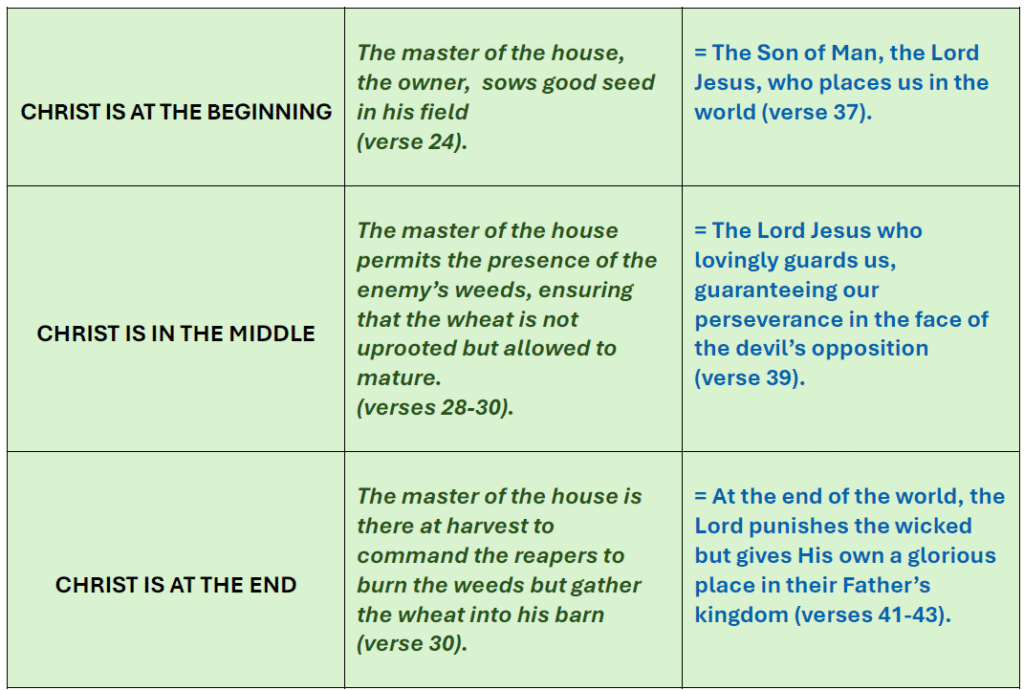
Pray often that everything about us – beginning, middle, and end – will reflect our worthy and pre-eminent Lord (Colossians 1:18).
Let it be seen that with You I have been,
Jesus, my Lord and my Saviour.
Let it be known I am always Your own,
by all my speech and behaviour.
You know, the devil detests prayer like that! Here is the devil in the parable: “his enemy came and sowed weeds among the wheat and went away”. Experts tell us that these weeds looked very similar to wheat. But they were not actually wheat A London minister, Campbell Morgan, used to talk about “the devil’s mission of imitation.”
So, how do we tell which is which? The servants suggest weeding the field immediately. But the owner’s command was, “Let both grow together”. There is a risk of mistaking the good seedlings for weeds. Patience over the weeks ahead and, ultimately, the harvest will show up the difference between the two. The heart-throb of the Saviour is to get His flock to heaven and neither obstruction nor opposition from Satan will deny it.
But His wise plan includes that we live side by side for a time with great wickedness in the world. Why might that be? Why must we continually watch out for our “adversary the devil who prowls around like a roaring lion, seeking someone to devour” (1 Peter 5:8)? Because it pleases the Lord to allow wickedness to be seen for what it really is. And it His desire that we patiently endure everything so that He might have all the glory and all the praise. The Lord’s harvest-time will show that He not only saved us but kept us.
That reminds me of something I read a long time ago about a simple Christian who left instructions for a headstone to mark his grave. It was to record his name and just one other word: “KEPT”. Now there’s an idea!
Not to us, O Lord, not to us, but to your name give glory,
for the sake of your steadfast love and your faithfulness!
Psalm 115:1